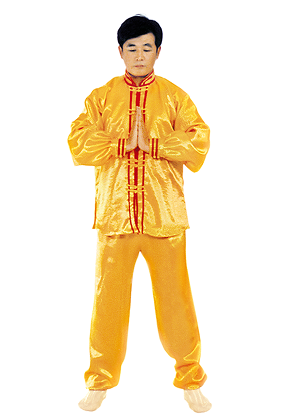
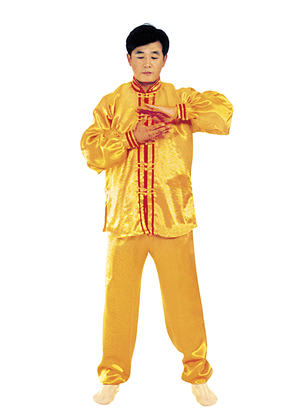
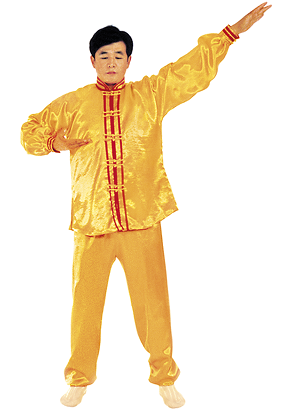
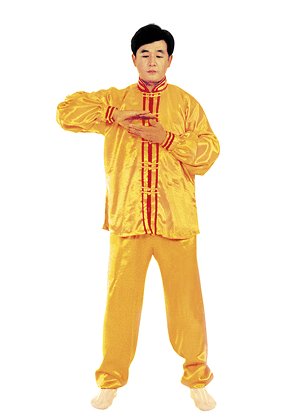
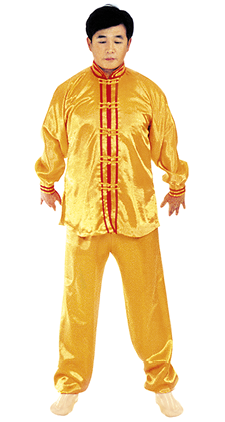
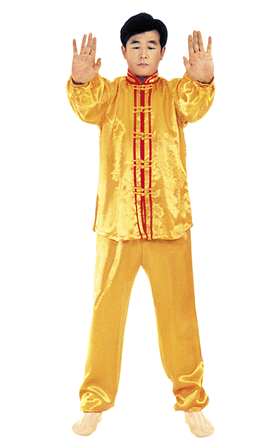
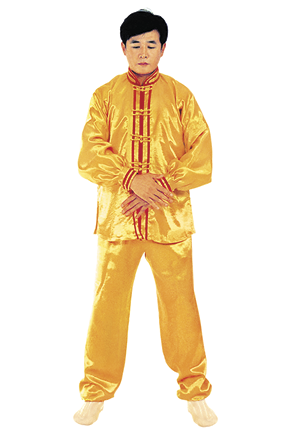
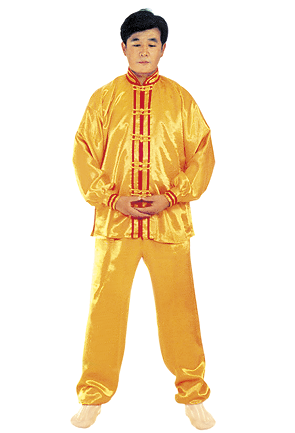
Falun Gong is a special type of Buddhist spiritual practice with several unique features that set it apart. In the past, it was an advanced form of spiritual practice with an accelerated approach that was only suitable for those few with outstanding character or great spiritual makeup. So it was not something readily shared with a wider audience. But it has now been reworked into a format suitable for disseminating more widely. This makes it understandable to those who do qigong, who will nowbe able to benefit from it; and it will meet the needs of the many who seek spiritual growth. Even in this reworked form, the practice still far surpasses most others both in terms of what is learned and the level at which it operates.
Not only can those who practice Falun Gong swiftly increase their spiritual strengthand powers, but also, in a short span of time, develop an extremely powerful falun. Once formed, the falun will normally turn nonstop at the position of the lower abdomen, and ceaselessly draw in and transform energy from the universe. Ultimately that energy will be rendered in one’s body into the higher form of energy known as gong. With the falun at work, the goal that we had in mind—of having the practice be automated, in effect—is fulfilled.
The practice consists of five exercises: Buddha Extending Numerous Arms, Falun Standing Meditation, Channeling Energy From the Two Cosmic Extremes, The Falun Method of Circulating Energy, and Strengthening Higher Powers.
Buddha Extending Numerous Arms
(Fo Zhan Qianshou Fa)16
Explanation: Stretching is at the heart of the first exercise, Buddha Extending Numerous Arms. It allows energy to flow throughout all of the body’s energy channelsunimpeded. Those who are new to energy practices will find that energy comes to them quickly by doing this exercise, while those who are experienced with energy practices will find that it enables them to rapidly make further progress. With this exercise energy will be pumped through, and will open up, all of the energy channelsright from the outset, which means that one is practicing at quite an advanced level. The movements involved are rather simple, which is a hallmark of practices of the Great Way—simple and straightforward. Simple as the movements may be, the exercise holistically directs the development of all that’s meant to be generated by the practice. While doing the exercise one will have a unique sensation of the body warming and the presence of a strong field of energy. That is the result of all of the energy channels in one’s body having been expanded and connected. The exercise aims to unblock the flow of energy and ensure that it travels unimpeded. It mobilizes the qiinside the body and under the skin so that it moves fast and vigorously, and this serves to draw into the body large amounts of energy from the universe. Along with this, one is quickly able to experience what is known in qigong as “having an energy field.” This exercise is foundational to our practice, and is generally done first, before the other exercises. You can think of it as one way to boost your practice.
(pinyin romanization)
Shen shen he yi,
Dong jing sui ji,
Ding tian du zun,
Qian shou fo li.18
(phonetic rendering)
shun-shun huh-ee
dohng-jing sway-jee
ding-t’yen doo-zun
chyen-sho foah-lee
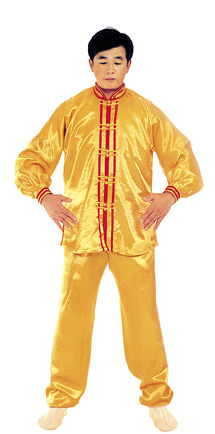
Preparation – Relax the entire body, but don’t slouch. Stand naturally, with feet shoulder-width apart. Bend the knees slightly. Keep the knees and hips relaxed. Tuck your chin in slightly. Touch the tip of the tongue to the hard palate. Leave a little space between the teeth. Close the lips and gently close the eyes. Maintain a serene expression on the face. During the exercise you will have the feeling that you are very large and tall.
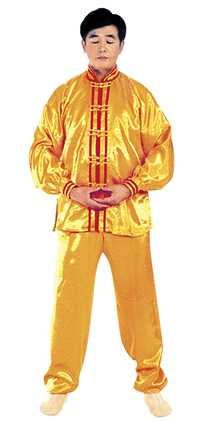
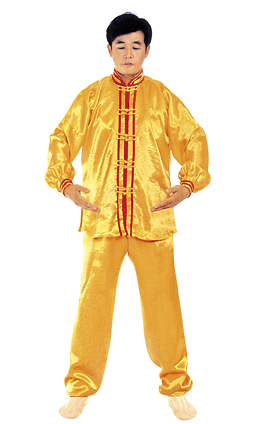
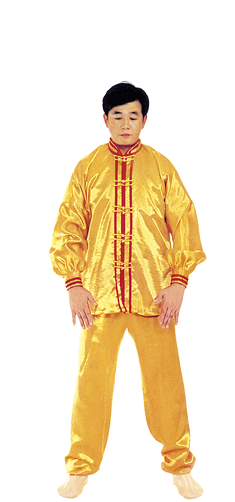
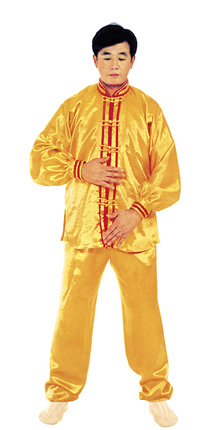
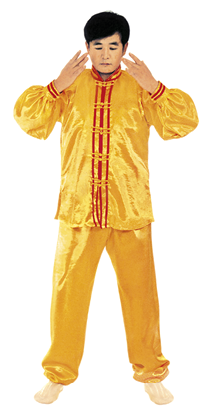
Conjoining the Hands (Liangshou Jieyin)19 – Lift both hands slightly with the palms facing up. Have the thumb tips lightly touch each other. Let the other four fingers of each hand meet and overlap on top of each other. For males the left hand is on top; for females the right hand is on top. Have the hands form an oval shape and hold them at the lower abdominal area. Hold both upper arms slightly forward with the elbows suspended so that the underarms are open (see Figure 1-1).
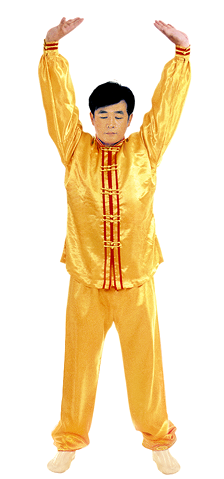
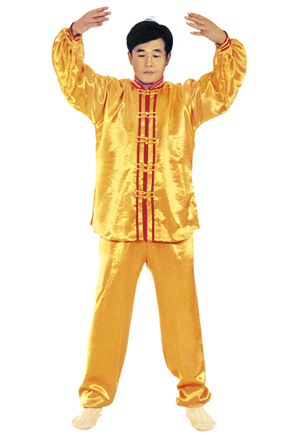
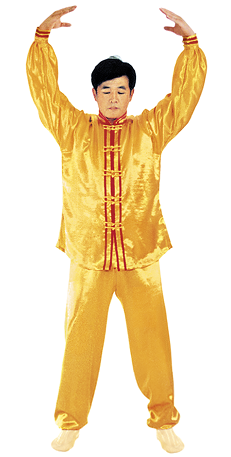
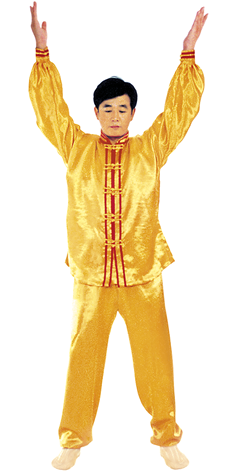
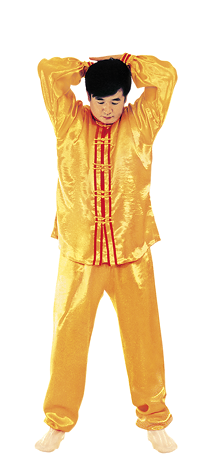
Maitreya Stretching His Back (Mile Shenyao)20 – Begin with hands conjoined (Jieyin). While raising the conjoined hands, straighten both legs gradually. When the hands reach the front of the face, separate them and gradually turn both palms upward. Once the hands are above the top of the head, have the palms face up and the fingers of both hands point toward each other, with a distance of 20-25 cm (8-10 inches) between them (Fig. 1-2). At the same time, push the head upward and press the feet downward on the ground. Press up hard with the heels of both palms and stretch the body for about 2 to 3 seconds. Then relax the whole body abruptly; remember to bring the knees and hips back to a relaxed position.
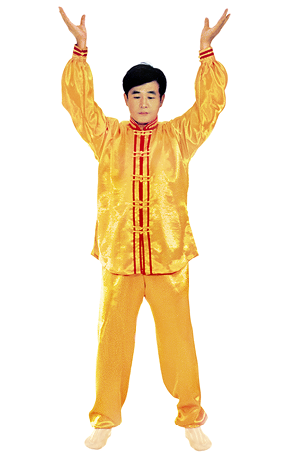
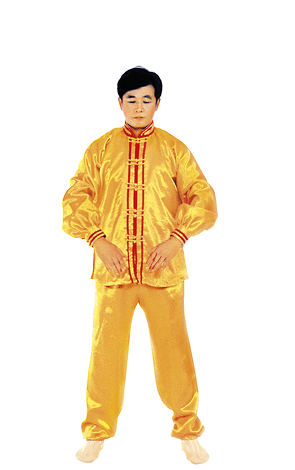
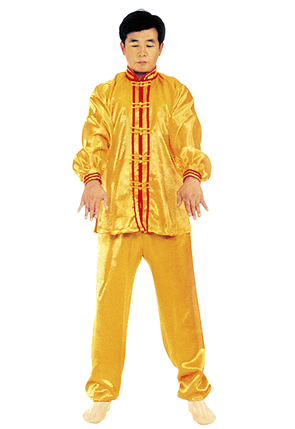
Tathagata21 Funneling Energy In (Rulai Guanding)22 – Following from the above position, turn your palms outward 140° to both sides simultaneously, so that the insides of the wrists face each other, forming a funnel shape. Straighten the wrists and move them downward (Fig. 1-3). When the hands reach the front of the chest, have the palms face the chest at a distance of about 10 cm (4 inches). Continue moving both hands down until they reach the lower abdomen (Fig. 1-4).
Putting the Palms Together (Shuangshou Heshi)23 – When reaching the lower abdominal area, without pausing, lift the hands up to the chest and put them together (Heshi) (Fig. 1-5). When doing Heshi, press both the fingers and the heels of the palms against each other, keeping a hollow space between the palms. Hold the elbows up, with the forearms forming a straight line. (Keep hands in the Lotus Palm position,24 except when putting hands together (Heshi) or conjoining them (Jieyin); the same applies to the following exercises.)
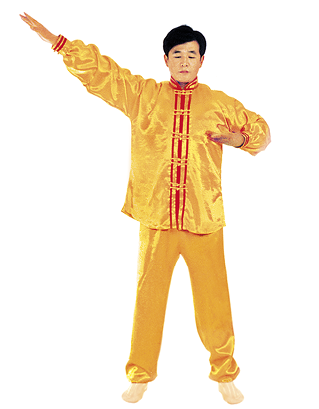
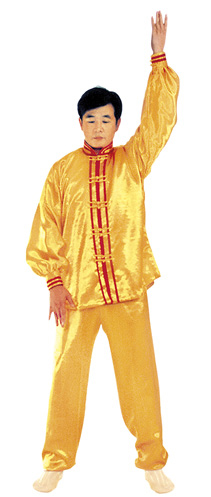
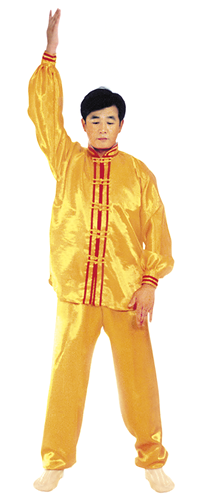
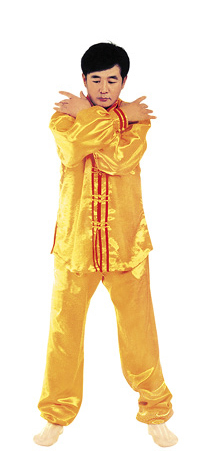
Pointing to Heaven and Earth (Zhangzhi Qiankun)25 – Starting from the position of Heshi, separate the hands 2-3 cm (1 inch) and start to turn them. Males are to turn the left hand (females, the right hand) towards the chest and turn the other hand outwards, so that the left hand is on top and the right hand is on the bottom (for females, the opposite). Both hands should make a straight line with the forearms (Fig. 1-6). Next, extend the top forearm diagonally upward with the palm facing down, until the hand reaches the level of the head. Keep the other hand at the chest with the palm facing up. As the top arm extends, stretch the entire body gradually, push the head upward, and press the feet downward. Stretch the top arm upward in the upper left direction (females, the right direction), while the arm that is in front of the chest stretches outward along with the raised arm (Fig. 1-7). Stretch for about 2 to 3 seconds, then relax the entire body abruptly. Bring the raised arm down to the front of the chest and to Heshi. Next, turn the palms again. The right hand (females, the left hand) is on top and the left hand is at the bottom (Fig. 1-8). The top arm repeats the previous movements just done; that is, extend the forearm diagonally upward with the palm facing down, until the hand has reached as high as the head. Keep the other arm at the chest with the palm facing upward. After stretching (Fig. 1-9), relax the entire body abruptly. Bring the hands to the front of the chest and put them together in Heshi (Fig. 1-5).
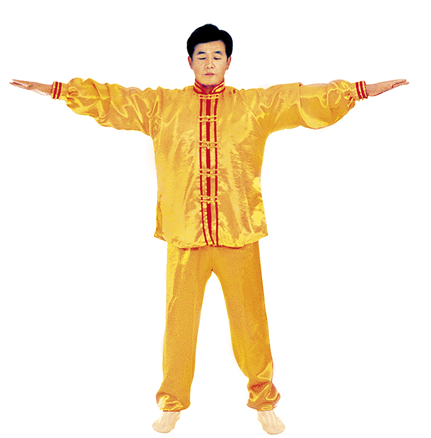
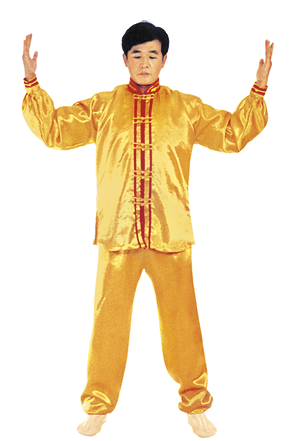
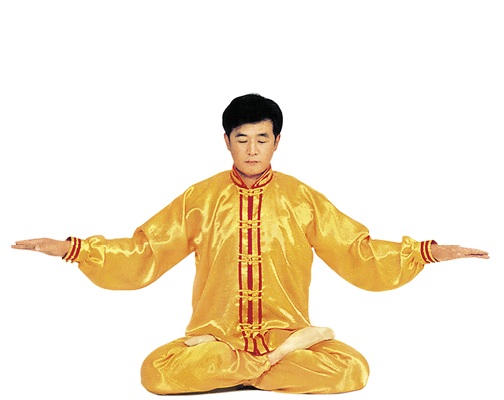
Monkey King Multiplying His Body (Jinhou Fenshen)26 – Begin with the Heshi position. Separate the hands at the chest and extend them outward to the sides of the body, forming a straight line with the shoulders. Gradually stretch the entire body. Push the head upward, press the feet downward, and stretch the arms hard out to the sides. Stretch in these four directions (Fig. 1-10) for 2-3 seconds. Relax the entire body abruptly and put the hands together in Heshi.
Twin Dragons Entering the Sea (Shuanglong Xiahai)27 – From Heshi, separate the hands and extend them downward towards the lower front of the body. When the arms are parallel and straight, they should form an angle of about 30° with the legs (Fig. 1-11). Stretch the whole body. Push the head upward and press the feet downward. Stretch for about 2-3 seconds, then relax the entire body abruptly. Draw back the hands and put them together in Heshi.
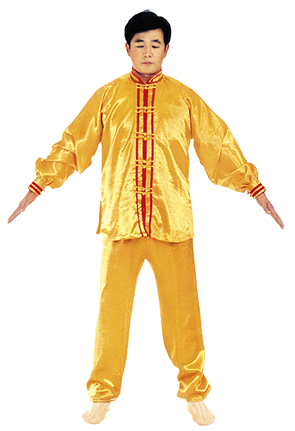
Bodhisattva Touching the Lotus (Pusa Fulian)28 – From Heshi, separate the hands and extend them diagonally downward to the sides of the body, with the angle between the arms and the legs at about 30° (Fig. 1-12). Stretch the whole body gradually, while the fingertips stretch out downward with a little force. Then, relax the entire body abruptly. Bring the hands toward the chest and put them together in Heshi.
Arhat Carrying a Mountain on His Back (Luohan Beishan)29 – Begin with the hands in Heshi. Separate the hands and extend them behind the body. At the same time, turn both palms to face backward. When the hands are passing the sides of the body, slowly flex the wrists. When the hands reach behind the body, the angle between the wrists and the body should be 45° (Fig. 1-13). Stretch the entire body gradually. After the hands reach the proper position, push the head upward and press the feet downward. Keep the body upright, and stretch for about 2-3 seconds. Relax the entire body abruptly. Draw back the hands and return them to Heshi.
Vajra30 Pushing a Mountain Away (Jingang Paishan)31 – Begin with the hands in Heshi, then separate them and push forward with the palms. Have the fingers pointing upward and keep the arms at shoulder level. Once the arms are straight, push the head upward and press the feet downward. Keep the body upright (Fig. 1-14). Stretch for 2-3 seconds, then relax the entire body abruptly. Put the hands together in front of the chest to form Heshi.
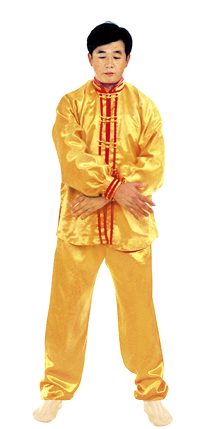
Overlapping the Hands in Front of the Lower Abdomen (Diekou Xiaofu)32 – Begin with the hands in Heshi. Slowly move the hands downward, turning the palms to face the abdominal area. When the hands reach the lower abdominal area, overlap them. For males, the left hand goes on the inside; for females, the right hand goes on the inside. Have the palm of the outer hand facing the back of the inner hand. Keep a distance of 3 cm (1 inch) between the hands and another 3 cm (1 inch) between the inner hand and the lower abdomen. Usually the hands are kept this way for 40 to 100 seconds (Fig. 1-15).
Finish the exercise by conjoining the hands inthe Jieyin position (Fig. 1-16).
Falun Standing Meditation
(Falun Zhuang Fa)33
Explanation: The second exercise of Falun Gong is categorized as a standing meditation. The exercise consists of four wheel-holding positions, which are quite similar to one another. Each position must be held for a long time. For those who are new to such exercises, the arms might feel quite heavy and tired in the beginning, when holding the positions. After finishing the exercise, however, the body will feel light and energized, and not fatigued as one would with physical labor. As the length of time doing the exercise increases, and one does it more times, one might come to experience a sensation of holding a turning falun between the arms while doing the exercise. Doing the exercise frequently will flood the body with energy and foster spiritual strength. The Falun Standing Meditation is a holistic way to increase one’s wisdom, elevate spiritually, and strengthen one’s higher powers at the same time. Though the exercise is quite simple, the things it develops are quite numerous and comprehensive. The poses involved should be natural, and, throughout the exercise, one should stay aware that one is practicing. There shouldn’t be any swaying, though a little movement is normal. As with the other exercises of Falun Gong, there is no step done to “end” the energy work. That’s because thefalun is always turning and its rotation should never be stopped or ended. The length of time that each individual is able to do the four positions for will vary from person to person, but the longer, the better.
verse:
(pinyin romanization)
Sheng hui zeng li,
Rong xin qing ti,
Si miao si wu,
Falun chu qi.34
(phonetic rendering)
shung-hway zung-lee
rohng-shin ching-tee
szz-meow szz-woo
fah-lun choo-chee
Preparation – Relax the whole body, but don’t slouch. Stand naturally, with feet shoulder-width apart. Bend the knees slightly. Keep the knees and hips relaxed. Tuck your chin in slightly. Touch the tip of the tongue to the hard palate. Leave a little space between the teeth. Close the lips and gently close the eyes. Maintain a serene expression on the face.
Conjoin the hands in Jieyin.
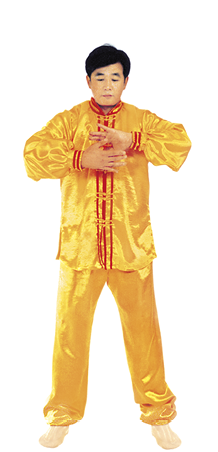
Holding the Wheel in Front of the Head (Touqian Baolun)35 – Start with the hands in Jieyin (Fig. 2-1). Slowly raise both hands from the lower abdomen, separating them in the process. When the hands have reached the front of the head, have the palms point toward the face at eyebrow level. Have the fingertips of the hands point toward each other, with 15 cm (5 inches) between them. Form a circle with the arms and relax the whole body (Fig. 2-2).
Holding the Wheel in Front of the Lower Abdomen (Fuqian Baolun)36 – Slowly bring both hands downward from the previous position. Keep the wheel-holding position unchanged as they reach the lower abdominal area. Keep a distance of about 10 cm (4 inches) between the hands and the abdomen. Hold the elbows forward, keeping the underarms open. Have the palms face up and the fingers of the hands point toward each other, with a distance of 10 cm (4 inches) between them. The arms should form a circle (Fig. 2-3).
Holding the Wheel Above the Head (Touding Baolun)37 – From the previous position, raise the arms slowly, maintaining the circular shape. Hold the wheel above the head with the fingers pointing toward each other. Keep the palms facing downward, with a distance of 20-30 cm (8-12 inches) between the fingertips of the two hands. The arms should form a circle. Keep the shoulders, arms, elbows and wrists relaxed (Fig. 2-4).
Holding the Wheel at the Sides of the Head (Liangce Baolun)38 – Starting from the previous position, slowly move the hands downward to the sides of the head. Keep the palms facing the ears, the forearms upright, and the shoulders relaxed. Don't hold the hands too close to the ears (Fig. 2-5).
Overlapping the Hands in Front of the Lower Abdomen (Diekou Xiaofu) – Slowly move both hands down from the previous position to the lower abdomen. Overlap the hands (Fig. 2-6). Finish the exercise by doing Jieyin (Fig. 2-7).
Channeling Energy From the Two Cosmic Extremes
(Guantong Liangji Fa)39
Explanation: This exercise brings together and blends the energies of the universe with the energies inside the body. The volume of inbound and outbound energy exchanged is immense. It allows one to, in a short span of time, drive malignant and dark energy out of the body and to draw in large amounts of energy from the universe. This has a purifying effect on the body. One can quickly achieve what is known as a “pristine white body.” Along with this, the flow of energy in this exercise can serve to push open the energy channels at the crown of the head as well as to flush open those at the soles of the feet.
Before doing the exercise, picture yourself as two massive hollow tubes that extend all the way to the sky, taller than anything. Your arms will move up and down during this exercise, driving the energy in your body to move upward and downward in kind. When the energy moves upward, it passes out of the crown of the head and travels all the way to the furthest upper reaches of the universe. When the energy moves downward, it passes out of the feet and travels all the way to the furthest lower reaches of the universe. When your arms change direction, energy returns to your body from the two furthest reaches, before shooting out once again in the opposite direction. This happens repeatedly for nine rounds. During the ninth round, the left arm for men (or right for women), which has just extended to the furthest upper position, should stay there and wait for the other arm to come up. Then the two arms proceed downward together to a full lower extension, before coming back up and passing across the body, driving the energy upwards. After nine rounds of moving the two arms together like this, when the energy is brought back into your body, your hands should move to the lower abdomen area and turn your falun clockwise. This will swirl other external energies into the body. After doing this turning, you should form the mudra of Jieyin. Though this concludes the exercise, the mechanisms behind it will still be at work.
verse:
(pinyin romanization)
Jing hua ben ti,
Fa kai ding di,
Xin ci yi meng,
Tong tian che di.40
(phonetic rendering)
jing-hwa bun-tee
fah-kye ding-dee
shin-tszz ee-mung
tohng-t’yen chuh-dee
Preparation – Relax the entire body, but don’t slouch. Stand naturally, with feet shoulder-width apart. Bend the knees slightly. Keep the knees and hips relaxed. Tuck your chin in slightly. Touch the tip of the tongue to the hard palate. Leave a little space between the teeth. Close the lips and gently close the eyes. Assume a serene expression on the face. Conjoin the hands in Jieyin (Fig. 3-1), then put them together in Heshi in front of the chest (Fig. 3-2).
Flushing the Body with Energy in Opposite Directions (Danshou Chong’guan)41 – From the Heshi position, the exercise starts with singular arm movement in which the arms glide slowly along with the energy mechanisms outside the body. Following along with the movements of the arms, the energy inside the body flows up and down continuously. For males, bring the left arm up first (Fig. 3-3); for females, bring the right arm up first. Slowly bring up the arm, passing along the front side of the face and extending it above the top of the head. Simultaneously, slowly lower the other arm. Keep alternating the arms in this way (Fig. 3-4). Keep both palms facing toward the body at a distance of 10 cm (4 inches). When doing the exercise, keep the entire body relaxed. One up-and-down movement of the arms is counted as one time. Repeat a total of nine times.
Flushing the Body with Energy in the Same Direction (Shuangshou Chong’guan)42 – At the ninth singular-arm movement, the left arm (females, the right arm) stays up and waits while the other arm is brought up. Both hands are pointing upward (Fig. 3-5). Next, move both arms downward at the same time (Fig. 3-6). Keep the palms facing the body at a distance of 10 cm (4 inches). One up-and-down movement of the arms is counted as one time. Repeat nine times.
Turning the Falun with Both Hands (Shuangshou Tuidong Falun)43 – After completing the double-arm movements, move both arms downward past the face and over the chest until reaching the location of the lower abdomen. Now turn the falun at the lower abdomen (Fig. 3-7, 3-8, and 3-9), with the left hand inside for males and the right hand inside for females. Keep a distance of 4 cm (1 inch) between the hands and between the inner hand and the lower abdomen. Turn the falun clockwise (as viewed from the front) four times to spin the energy from outside back to the inside of the body. When turning the falun, keep the movements of the hands within the area of the lower abdomen.
Conjoin the Hands (Liangshou Jieyin) (Fig. 3-1)
The Falun Method of Circulating Energy
(Falun Zhoutian Fa)44
Explanation: This exercise can drive the energy in the body to flood through the meridian system, rather than just goingthrough one or two channels. It promotes the continuous circulation of energy from the entire yin side of the body to its yang side, and vice versa, over and over again. This is vastly superior to the typical methods of moving energy through one’s channels, be it via what are known as “greater” or “lesser” circulation paths. It counts as an intermediate level exercise in Falun Gong. With the groundwork done by the three prior exercises, this one can quickly open up all of the body’s energy channels (including the greater paths)—and gradually connect the channels of the entire body, from top to bottom. The defining feature of this exercise is that it utilizes the rotation of the falun to correct anything that isn’t right in the body. It can enable the microcosm that is the human body to return to its most pristine state, where there is no impediment to any of the energy channels. Reaching this stage of practice means that one has achieved great heights in the Three Realms phase of spiritual development, and those with a great spiritual makeup will be able to advance to the next stage of practice in the Great Way. Both one’s spiritual strengthand one’s higher powers will have been greatly enhanced by this point. When doing this exercise one’s hands should follow along with the energy mechanisms, and move in a steady, slow, and smooth manner.
verse:
(pinyin romanization)
Xuan fa zhi xu,
Xin qing si yu,
Fan ben gui zhen,
You you si qi.45
(phonetic rendering)
shwen-fah jhr-sheeu
shin-ching szz-yoo
fahn-bun gway-juhn
yo-yo szz-chee
Preparation – Relax the entire body, but don’t slouch. Stand naturally, with feet shoulder-width apart. Bend the knees slightly. Keep the knees and hips relaxed. Tuck your chin in slightly. Touch the tip of the tongue to the hard palate. Leave a little space between the teeth. Close the lips and gently close the eyes. Maintain a serene expression on the face.
Conjoin the hands in Jieyin (Fig. 4-1), then put the hands together in Heshi in front of the chest (Fig. 4-2).
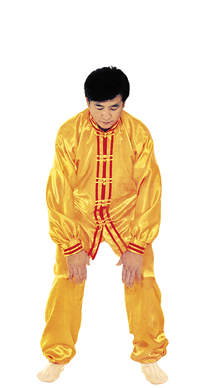
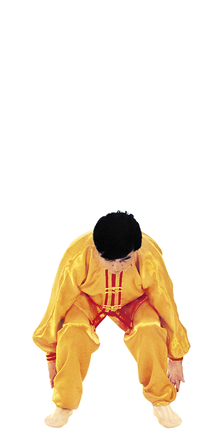
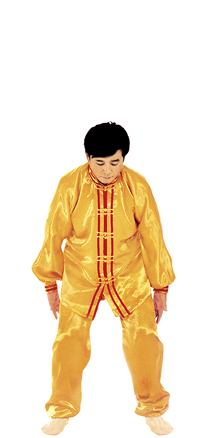
Separate the hands from Heshi. Move them down to the lower abdomen while turning both palms to face the body. Keep a distance of about 10 cm (4 inches) between the hands and the body. After the hands have passed along the lower abdomen, extend them further downward along the inner sides of the legs and, at the same time, bend at the waist and squat down (Fig. 4-3). When the fingertips get close to the ground, move the hands in a circle, going from the front of the feet along the outsides of the feet to the heels (Fig. 4-4).
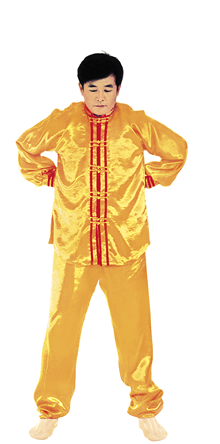
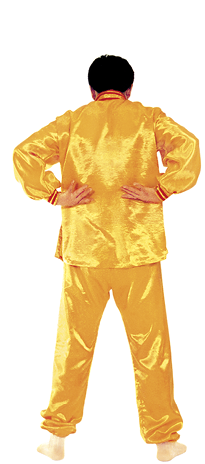
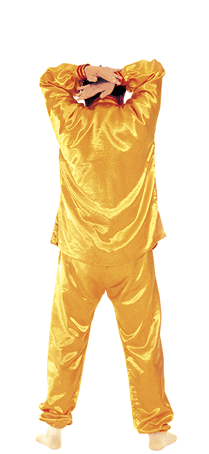
Then, bend both wrists slightly and bring the hands up along the backs of the legs (Fig. 4-5). Straighten the waist while lifting the hands up along the back (Fig. 4-6). During the exercise, don’t let either hand touch any part of the body, or the energy on them will be taken back into the body. When the hands cannot be lifted any higher [along the back], make hollow fists (Fig. 4-7), then pull them forward passing through the underarms. Cross the arms in front of the chest (There is no special requirement for which arm is to be above and which below—it depends on what’s natural for the individual. This is the case for both males and females.) (Fig. 4-8). Open the hollow fists and place the hands over the shoulders (leaving a space). Move both palms along the outer (yang) sides of the arms. When reaching the wrists, turn the hands so the palms face each other at a distance of 3-4 cm (1.25 to 1.5 inches). That is, the outer thumb is now turned to be on top and the inner thumb is below. At that time, the hands and the arms should form a straight line (Fig. 4-9). Turn both palms as if holding a ball; that is, the outside hand is turned so that it ends up inside and the inside hand is turned so that it ends up outside. As both hands push along the inner (yin) sides of the lower and upper arms, raise them up and over the back of the head (Fig. 4-10). The arms should form an “x” at the back of the head. Next, continue to move the hands further down toward the backbone (Fig. 4-11). Separate the hands, with the fingertips pointing downward, and connect with the energy of the back. Then move both hands in parallel over the top of the head to the front of the chest (Fig. 4-12). This then completes one circuit. Repeat the movements nine times. After completing the exercise, move the hands down along the chest to the lower abdomen.
Overlap the hands in front of the lower abdomen (Diekou Xiaofu) (Fig. 4-13), and then conjoin the hands in Jieyin (Fig. 4-14).
Strengthening Higher Powers
(Shentong Jiachi Fa)46
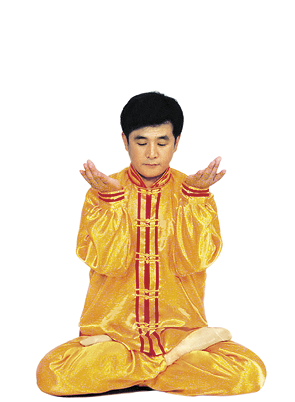
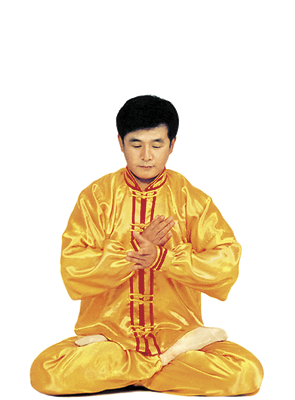
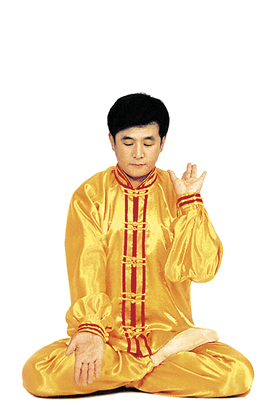
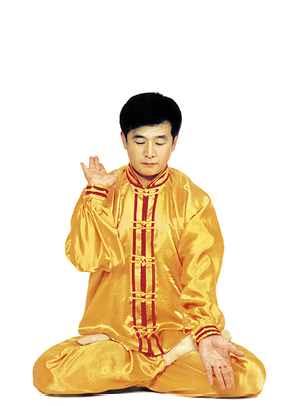
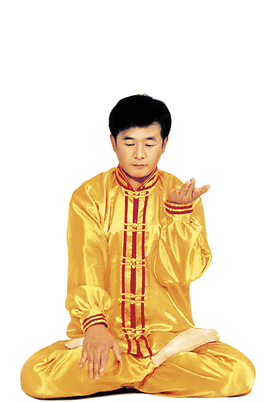
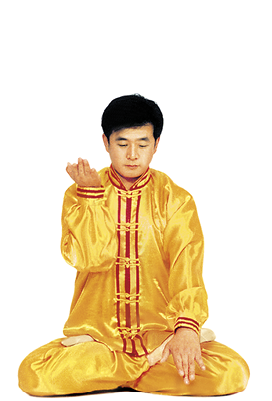
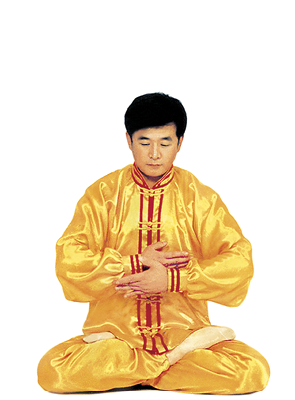
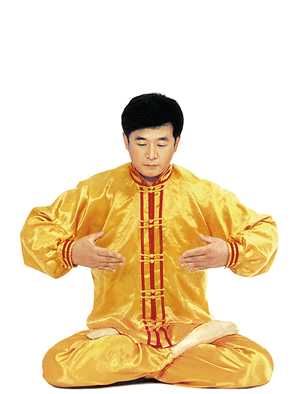
Explanation: Strengthening Higher Powers is Falun Gong’s other meditation exercise. It utilizes Buddhist mudras to turn the falun in ways that strengthen one’s higher powers (including extrasensory abilities) as well as one’s spiritual strength. It is a multi-faceted exercise. It is categorized as an advanced exercise, and was previously kept secret. I purposely made this exercise public in order to meet the needs of those who come to the practice with a solid foundation, and I hope it can help those who are predestined. This exercise is done with the legs crossed, in the lotus position. Ideally it will be done in the full-lotus position, though half-lotus is also acceptable. Energy flows quite strongly during this exercise, and there is a rather strong field of energy around one’s body. One should move one’s arms in keeping with the energy mechanisms that I bestow. When moving the arms, they should follow along with their natural inclination. And when doing the positions for enhancing higher abilities, the mind should be empty, with just a slight bit of attention going to the palms of the hands. The centers of the palms might feel warm, heavy, tingly, that a phantom object is there, or other sensations. But you shouldn’t try to will these things to happen; just let it come about naturally. The longer you can stay in the lotus position, the better; but just do what’s within your means. That said, the longer the time, the more intense the exercise will be and the faster one’s higher energy will develop. You should progressively enter into a serene state as you do the exercise (not thinking about anything, nor trying to affect things with your mind). From a calm but somewhat dynamic state, gradually enter into deep meditation while staying aware that you are present and meditating.
verse:
(pinyin romanization)
You yi wu yi,
Yin sui ji qi,
Si kong fei kong,
Dong jing ru yi.47
(phonetic rendering)
yo-ee woo-ee
yin-sway jee-chee
szz-kohng fae-kohng
dohng-jing ru-yee
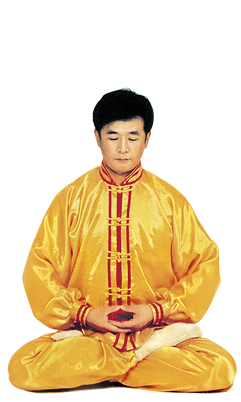
Conjoin the Hands (Liangshou Jieyin) – Sit with legs crossed in the lotus position. Relax the entire body, but don’t slouch. Keep the waist and neck upright. Tuck in the chin slightly. Touch the tip of the tongue to the hard palate, leave a space between the teeth, and close the lips. Gently close the eyes. Fill the heart with compassion. Assume a peaceful and serene expression on the face. Conjoin the hands in Jieyin at the lower abdomen, and gradually enter into stillness (Fig. 5-1).
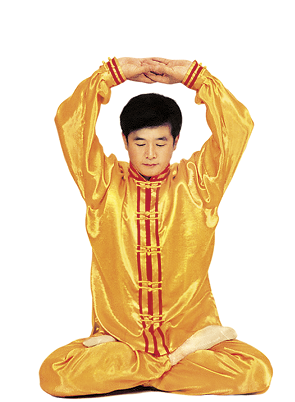
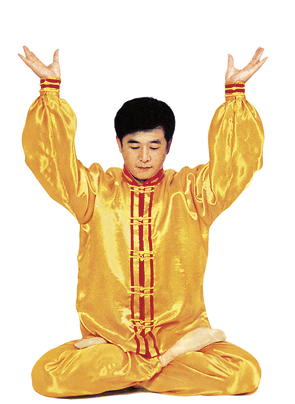
First Mudra –When moving the arms, they should follow along with their natural inclination, gliding along with the energy mechanisms set up by the teacher. The movements should be carried out in a steady, slow, and smooth way. Slowly raise both hands in the Jieyin position until reaching the front of the head. Then, gradually turn the palms to face upward. When the palms are facing up, the hands will have reached their highest point (Fig. 5-2). Next, separating the hands, draw an arc over the head, turning them out to the sides until they reach the front side of the head (Fig. 5-3). Immediately after, slowly lower the arms. Try to hold the elbows inward, with palms facing up and fingers pointing toward the front (Fig. 5-4). Next, straighten both wrists and cross them in front of the chest. For males, the left hand goes outside; for females, the right hand goes outside (Fig. 5-5). When a straight line is formed by the arms and hands, rotate outward the wrist of the hand on the outside, with the palm turned to face upward. Draw a semicircle, and turn the palm to face upward with fingers pointing toward the back. The arm should use some force. Turn downward the palm of the hand that was inside after crossing in front of the chest. Straighten the arm. Rotate the arm and hand so the palm faces outward. The arm in the lower front of the body should form an angle of 30° with the body (Fig. 5-6).
Second Mudra – Following from the previous position (Fig. 5-6), the upper hand moves to the inside. Turn the palm of the upper hand toward the body and simultaneously move the lower hand up. The movement is the same as in the first mudra, with the left and right hands switched. The positions of the hands should be exactly the opposite of before (Fig. 5-7).
Third Mudra – Straighten the right wrist for males (left for females) with the palm facing the body. After the right (or left) hand moves across in front of the chest, turn the palm to face down and move it down to the lower front where the shin is located. Keep the arm straight. Males, turn the left wrist (females, the right) while moving it up and passing the right hand with the palm facing the body. At the same time, move the palm toward the left (females, the right) shoulder. When the hand has reached its position, the palm faces up and the fingers point forward (Fig. 5-8).
Fourth Mudra – This is the same mudra as shown above, but with the hands in opposite positions. The left hand for males (right for females) moves on the inside, and the right hand (left for females) moves on the outside. The movements just switch the left with the right hand. The hands are in opposite positions (Fig. 5-9). When doing all four mudras the movements are continuous, without interruption.
Strengthening Sphere-Shaped Powers – Continuing from the fourth mudra, the upper hand moves on the inside with the lower hand moving on the outside. For males, the right palm (females, the left palm) gradually turns and moves down toward the chest area. The left hand for males (right for females) moves up. When both forearms reach the chest and form a horizontal line (Fig. 5-10), pull the hands apart toward the sides (Fig. 5-11) while turning the palms to face downward. When the hands extend beyond the outsides of the knees, bring the hands to waist level, with the forearms and the wrists at the same level. Relax the arms (Fig. 5-12). This position draws one’s internal powers out to the hands for strengthening what are sphere-shaped powers. When these are being strengthened, the centers of the palms may feel warm, heavy, tingly, that a phantom object is there, or experience other sensations.But you shouldn’t try to will these things to happen; just let it all come about naturally. The longer the position is held, the better. Hold it until you are too tired to endure it.
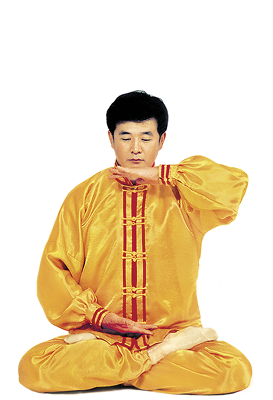
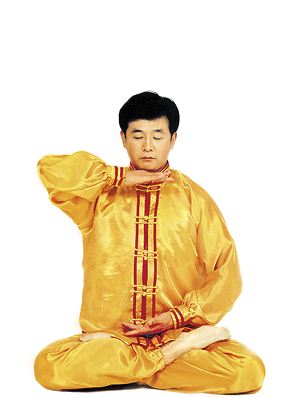
Strengthening Pillar-Shaped Powers – Following from the previous position, rotate the right hand (females, the left) so the palm faces upward and, at the same time, move it toward the lower abdominal area. When the hand has reached its position, keep the hand at the lower abdomen with the palm facing up. At the same time, while that hand is moving, lift the other hand and simultaneously move it toward the chin. Keep the hand as high as the chin and have the palm face downward. The forearm and the hand should be at the same level. At that time, both palms should face each other and stay in that position (Fig. 5-13). That strengthens pillar-shaped powers such as “palm thunder,” etc. Hold the position until you feel you can no longer do so. Next, with the upper hand, draw a semicircle in front of you while bringing the hand down to the lower abdominal area. Simultaneously lift the lower hand until it is right below the chin, while turning the palm to face down (Fig. 5-14). That arm should be at the same level as the shoulder, with the two palms facing each other. This strengthens one’shigher powers, too, only with the opposite hand positions. Hold the position until the arms become too tired to endure it.
Serene Meditation – From the last position, draw a semicircle downward with the upper hand (Fig. 5-15), bringing the hand down to the lower abdominal area. Conjoin the hands in Jieyin and begin to meditate serenely. Maintain a state of deep meditation—the longer the better.
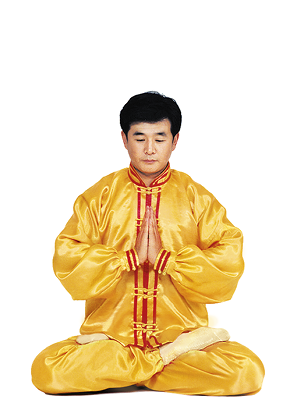
Ending Position – Press the hands together in front of the chest in Heshi (Fig. 5-16). Come out of meditation and the lotus position.
Essential Points for Practicing Falun Gong
1. The five exercises of Falun Gong can be done in order or not. But it’s suggested that you normally begin a session with the first exercise, which is best done three times. It is fine to do the other exercises without doing the first one. Each exercise can be done on its own.
2. Your movements should be accurate and the timing precise. Your hands and arms should glide along in the manner of a rounded path. Whether they are going up and down, back and forth, or left and right, they should always be following along with the energy mechanisms, and move in a steady, slow, and smooth manner. Avoid going too fast or slow.
3. Your conscious mind should be in charge during the exercises, as this mind is what Falun Gong develops. You shouldn’t try to experience swaying. If swaying does naturally occur, rein it in. You can open your eyes if you have to.
4. Relax your whole body, particularly at the knees and hips. Standing too rigidly can restrict the energy channels.
5. Your movements during the exercises should be relaxed and natural, with full extensions that look graceful. They should seem gentle but have strength behind them, and they should be connected together in a seamless flow. Although there should be some degree of strength to your movements, they shouldn’t be rigid or stiff. This will give you noticeably better results.
6. When you finish doing the exercises, your body is done moving but the energy mechanisms are not done. You need only do the mudra of Jieyin to end most of the exercises; conjoining the hands signifies that the exercise is done. You shouldn’t try to use your mind to end the session, such as to stop the energy mechanisms that are at work; the turning of the falun is not something that can be, or should be, stopped.
7. Those who are physically weak or chronically ill may do the exercises less or select those of the five that they can do. Those who can’t do the standing ones can do the seated meditation. It’s generally not a good idea to take time off from your daily practice routine.
8. There are no special criteria for when, where, or in what direction you are to do the exercises. But it is recommended that the setting be clean and quiet.
9. The exercises are done without trying to sense or direct energy in the body. This ensures that things won’t go awry in your practice. Do not combine our practice with any other, or your falun risks becoming deformed.
10. If you simply cannot quiet your mind as you do the exercises, you may repeatedly say your teacher’s name in your mind. With time, however, this will no longer be necessary.
11. You may experience ordeals as your practice, and they are one way by which karma is paid off. Everyone has karma. Don’t mistake discomfort in your body for illness. You might experience ordeals in an accelerated manner, which is done to reduce your karma and pave the way for your spiritual development.
12. If you can’t cross your legs to meditate at first, you can sit on the edge of a chair and benefit just the same. But those who do this practice must be able to do the lotus position eventually. You will surely be able to with time.
13. If you experience visions or see otherworldly things when doing the meditations, pay no heed to them and just continue on. If you are disturbed by a terrifying vision or you feel threatened, you should quickly remind yourself, “I am protected by Falun Gong’s teacher. There is nothing to fear,” or call out “Master Li.” And simply carry on with the exercise.
Falundafa.org > Books